Customs Clearance Automation: How AI Prevents Customs Holds and Fines in India

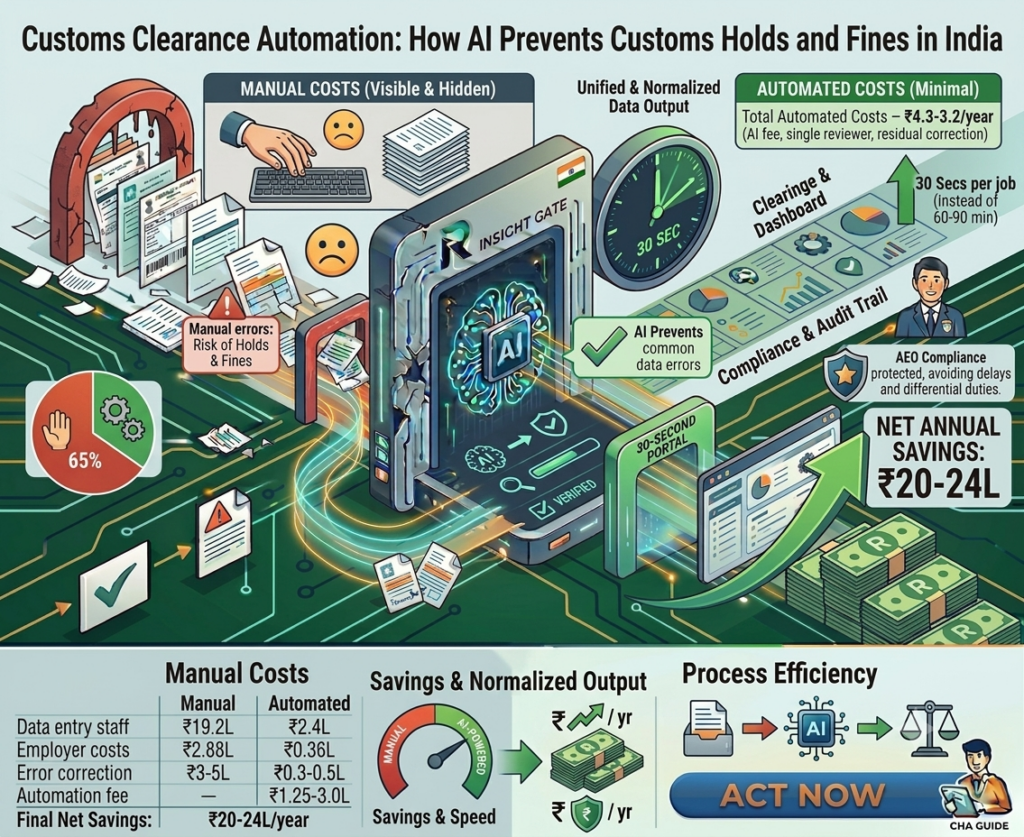
How much does manual document processing actually cost your clearing house agent operation?
Most CHA owners know the rough answer: “salaries for 6-8 data entry staff.” But that’s only the visible cost. The real number — when you include error correction, customs holds, rework, client churn from delayed clearances, and the opportunity cost of staff buried in typing instead of compliance review — is 30-40% higher than the salary line on your P&L.
This post lays out the complete cost picture, line by line. What does manual customs document processing actually cost a mid-sized CHA? What does AI-powered document automation cost to replace it? And the net savings math that makes this one of the clearest ROI cases in logistics technology today.
No vague “efficiency gains.” No “up to X%” hedging. Real numbers, transparent assumptions, verifiable math.
The true cost of manual customs document processing
Let’s build the cost model from the ground up for a mid-sized clearing house agent operation handling 500-1,000 import and export jobs per month.
Cost layer 1: Direct labor — ₹19.2 lakhs/year
The foundation. A CHA processing 500-1,000 jobs monthly typically employs 8 full-time data entry staff. Each staff member handles 4-6 jobs per day, spending 60-90 minutes per job manually reading Bills of Lading, commercial invoices, packing lists, and certificates of origin, then typing 70-80 fields per document into customs filing software.
| Labour Cost Component | Annual Cost |
| 8 data entry staff @ ₹20,000/month | ₹19.2L/year |
| Employer costs (PF, ESI, bonus, gratuity) ~15% | ₹2.88L/year |
| Training, attrition replacement (~2 staff/year) | ₹1.0L/year |
| TOTAL DIRECT LABOUR | ₹23.1L/year |
Most CHA owners stop here. But this is only 60-65% of the actual cost.
Cost layer 2: Error correction and rework — ₹3-5 lakhs/year
Manual data entry has a 5-10% error rate on complex documents. For a CHA processing 700 jobs per month with an average of 5 documents per job, that’s 350-700 documents per month with at least one extraction error. Each error triggers one or more of:
- Rework time: the reviewer catches the error internally, and the staff re-reads and corrects. 15-30 minutes per rework.
- Assessment query response: faceless assessment officer raises a query on mismatched data. Response prep takes 1-3 hours per query. Clearance delayed 24-72 hours.
- HS Code reclassification: wrong tariff code discovered at assessment. Requires re-filing, differential duty calculation, and sometimes penalty proceedings.
Cost layer 3: The hidden costs nobody budgets for
These costs don’t appear as line items. They show up as lost revenue, lost clients, and lost competitive position:
Client demurrage and detention: When clearance delays cause cargo to sit at port beyond the free period, the importer pays demurrage (to the port) and detention (to the carrier). The CHA doesn’t pay directly, but the client attributes the delay to the CHA’s processing speed. Over time, clients with high-value or time-sensitive cargo migrate to faster competitors.
Opportunity cost of staff time: Your 8 data entry staff spend 80% of their day typing. That’s 8 people who could be doing compliance review, client relationship management, or exception handling — work that actually differentiates your CHA and retains clients. Instead, they’re copying text from PDFs into forms.
Scaling ceiling: When business grows, manual operations scale linearly: more jobs = more staff. Hiring and training a new data entry operator takes 4-6 weeks. During peak season, you either turn away jobs or rush processing with higher error rates. Automation scales instantly.
AEO eligibility risk: Repeated errors erode your compliance score, risking AEO status downgrade. Losing AEO T2/T3 means losing facilitated clearance privileges that your best clients chose you for.
Conservative total cost of manual processing: ₹26-28 lakhs per year for a mid-sized CHA. The visible labor cost (₹19.2L) is barely two-thirds of the real number.
What customs document automation actually costs
Now let’s build the cost model for the same CHA operation after implementing AI-powered customs document automation:
| Automation Cost Component | Annual Cost |
| AI document processing platform fee | ₹1.25-3.0L/year (volume-based, scales with jobs) |
| 1 reviewer @ ₹20,000/month (verification + exceptions) | ₹2.4L/year |
| Employer costs for 1 reviewer (~15%) | ₹0.36L/year |
| Residual error correction (~0.5-1% error rate) | ₹0.3-0.5L/year |
| TOTAL AUTOMATED COST | ₹4.3-6.3L/year |
The platform fee varies by volume. Most mid-market CHAs processing 500-1,000 jobs monthly land in the ₹1.5-2.5L/year range. The single reviewer handles verification of AI-extracted data, exception cases, and quality audits — at 30 seconds per job instead of 60-90 minutes, one person easily covers the volume that previously required 8.
The net savings math — line by line
Here’s the complete before-and-after comparison:
| Cost Item | Manual (Current) | With AI Automation |
| Data entry staff | 8 FTEs @ ₹2.4L/yr = ₹19.2L | 1 reviewer = ₹2.4L |
| Employer costs (PF/ESI/bonus) | ₹2.88L | ₹0.36L |
| Training & attrition | ₹1.0L | Minimal |
| Error correction & rework | ₹3-5L | ₹0.3-0.5L |
| Automation platform fee | — | ₹1.25-3.0L |
| TOTAL ANNUAL COST | ₹26-28L | ₹4.3-6.3L |
| NET ANNUAL SAVINGS | ₹20-24L/year |
Even using the audit-compliant, conservative estimate (which excludes hidden costs such as demurrage, client churn, and opportunity costs), the net savings are ₹16-20 lakhs per year. Including the full cost layers detailed above, savings reach ₹20-24 lakhs.
Payback period: 3-5 months. The platform fee is the only new cost. Seven data entry salaries stop from month one. Most CHAs are cash-flow positive on the automation investment by the end of Q1.
Want To See These Numbers Applied to Your Operation?
We’ll walk through the extraction workflow on your actual documents and build a custom ROI model using your real staff count, salary costs, and job volume.
Book a Free DemoThe savings that don’t fit in a spreadsheet
The tables above capture the quantifiable costs. But some of the most valuable returns from customs document automation are strategic, not just financial:
1. Clearance speed becomes a competitive advantage
When your CHA clears shipments in hours instead of days, clients notice. Importers with time-sensitive cargo, such as perishables, fashion, electronics, and project materials, will actively choose the CHA that consistently delivers faster clearance. Under Customs 2.0, where Auto Out of Charge is available for clean filings, the CHA with the highest first-pass accuracy gets the fastest clearance times. That’s a client acquisition and retention advantage no amount of marketing can replicate.
2. Your team shifts from a cost center to a value center
Eight people typing data from PDFs is a cost center. One person doing compliance review, exception handling, and quality audit is a value center. The same payroll budget — minus seven salaries — can fund business development, client relationship management, or specialized compliance capabilities (hazmat, pharma, project cargo) that command premium fees.
3. Scaling without the hiring bottleneck
Manual operations scale linearly: 2x jobs = 2x staff. Recruiting, training, and retaining trained customs data entry operators in India’s job market is a 4-6-week-cycle per hire. During peak season — pre-festive imports, financial year-end, seasonal cargo — you either turn away business or process under pressure with higher error rates. AI-powered document processing automation scales instantly. Your cloud infrastructure handles 500 jobs the same way it handles 5,000. Peak season becomes a revenue opportunity, not an operational crisis.
4. AEO eligibility protection and enhancement
AEO T2 and T3 status provides tangible clearance benefits: fewer examinations, direct port delivery, and deferred duty payment. These benefits translate directly to faster clearance and lower costs for your clients. Maintaining AEO status requires consistently high compliance scores, which depend on data accuracy across every filing. AI-powered extraction with HS Code cross-referencing and cross-document validation systematically reduces the error rate that threatens AEO eligibility. Protecting AEO status protects your premium client relationships.
The three objections we hear — and the honest answers
“We tried OCR before, and it didn’t work.”
You probably tried template-based OCR. Template OCR needs a separate template for every shipping line format — 100 carriers means 100 templates to build and maintain. When formats change, templates break. Accuracy plateaus at 70-85%, and the manual correction overhead often negates the time savings. AI-powered document processing is fundamentally different: LLM-native extraction works with any format from Day 1, Vendor Memory learns each carrier automatically, and accuracy improves with every document rather than degrading. If template OCR burned you, that’s actually a reason this will work — the failure mode has been eliminated.
“My staff will resist the change.”
Your data entry staff spend their days doing work they don’t enjoy; copying text from PDFs for 6-8 hours straight. In our experience, the resistance comes from management, not from the staff. The operators who move from typing to reviewing report higher job satisfaction, fewer repetitive strain issues, and a sense that their expertise (catching errors, understanding compliance nuances) is finally being valued rather than buried under data entry volume.
“The upfront cost is hard to justify.”
There is no upfront cost. No setup fee, no implementation fee, no template-building fee. The platform fee starts from month one, but so do the savings — because seven data entry salaries stop from month one. The net cash flow is positive from the start. If you want proof before committing, the free 2-week pilot processes 500 of your real documents and delivers an accuracy benchmark report — at zero cost and zero commitment.
ROI by CHA operation size
The savings scale with your operation. Here’s how the math works across three typical CHA sizes:
| Metric | Small CHA (200 jobs/mo) | Mid CHA (700 jobs/mo) | Large CHA (2,000+ jobs/mo) |
| Data entry staff | 3-4 | 8 | 15-20 |
| Manual annual cost | ₹10-12L | ₹26-28L | ₹48-55L |
| Automated annual cost | ₹3-4L | ₹4.3-6.3L | ₹7-10L |
| Net annual savings | ₹7-8L | ₹20-24L | ₹40-45L |
| Payback period | 4-6 months | 3-5 months | 2-3 months |
| Staff redeployed | 2-3 to review/BD | 7 to review/BD/compliance | 14-18 to specialized roles |
The ROI case is strongest for mid-to-large CHAs, where labor costs are highest and the error-correction burden scales with volume. But even small CHAs see meaningful savings — because the platform fee at low volumes is correspondingly lower, and the operational benefits (speed, accuracy, scalability) apply regardless of size.
Ready to See the ROI for Your Specific Operation?
We’ll process 500 of your real customs documents and deliver an accuracy benchmark, along with a custom ROI projection based on your actual costs. Zero cost. Zero commitment.
Schedule a Demo NowFrequently Asked Questions about Customs Document Automation
A mid-sized clearing house agent processing 500-1,000 jobs per month typically saves ₹16-20 lakhs per year by switching from manual data entry to AI-powered document automation. This includes direct labour savings (7 of 8 data entry staff redeployed), error correction reduction (from ₹3-5L to under ₹0.5L annually), and the elimination of rework, assessment query response costs, and HS Code reclassification expenses. Including hidden costs like client demurrage attribution and AEO risk, savings can reach ₹20-24L.
Most mid-sized CHA operations achieve payback within 3-5 months. The automation platform fee is the only new cost, while seven data entry salaries stop from month one. Net cash flow is positive from the first month for most operations. Smaller CHAs (200 jobs/month) typically see payback in 4-6 months; larger operations (2,000+ jobs/month) in 2-3 months.
AI document processing platforms for CHAs typically use volume-based pricing that scales with your monthly job count. There are no setup fees, no template-building fees, and no per-format charges. For a mid-market CHA processing 500-1,000 jobs monthly, platform costs range from ₹1.25-3.0 lakhs per year. The total annual cost including one reviewer and residual error correction is ₹4.3-6.3L — compared to ₹26-28L for manual processing.
Not necessarily. Most CHAs redeploy staff rather than terminate. Data entry operators move to compliance review, exception handling, client relationship management, or business development roles. The ROI comes from eliminating the need for 7 of 8 positions to do manual typing — not from firing people. One reviewer remains for verification. The remaining team capacity can drive revenue through higher job volumes, premium services, or specialised compliance capabilities.
Yes, though the savings are proportionally smaller. A small CHA with 3-4 data entry staff saves ₹7-8 lakhs per year with a 4-6 month payback. The operational benefits — faster clearance, higher accuracy, scalability for growth — apply regardless of current volume. And if your goal is to grow the business, automation removes the staffing constraint that caps how many jobs you can handle.
AI-powered automation improves AEO eligibility and retention by systematically increasing data accuracy across every filing. HS Code cross-referencing, cross-document validation, and mandatory field completeness checks reduce the error rate that triggers RMS flags and assessment queries. Over time, this improves your compliance scores, lowers examination rates, and strengthens your AEO T2/T3 status — which provides faster clearance, fewer examinations, and direct port delivery privileges that your premium clients value.