HS Code Misclassification: How AI Prevents Customs Holds and Fines in India

8471.30.00 or 8471.41.00?
One classifies a portable digital computing machine weighing under 10 kg. The other classifies a digital automatic data processing machine. Both could describe the same laptop depending on how you read the goods description on the commercial invoice. Choose wrong, and the duty rate difference is the least of your problems.
HS Code misclassification is the single most expensive data error a clearinghouse agent can make. It doesn’t just change the customs duty amount. It triggers assessment queries from faceless officers, RMS flags that route your shipment to physical examination, penalty proceedings under Section 112 of the Customs Act, and in severe cases, cargo seizure under Section 111.
And under Customs 2.0, where CBIC has capped assessing officers at three queries per Bill of Entry and automated clearance rewards accuracy, HS Code errors are no longer absorbed by the system. They’re penalized by it.
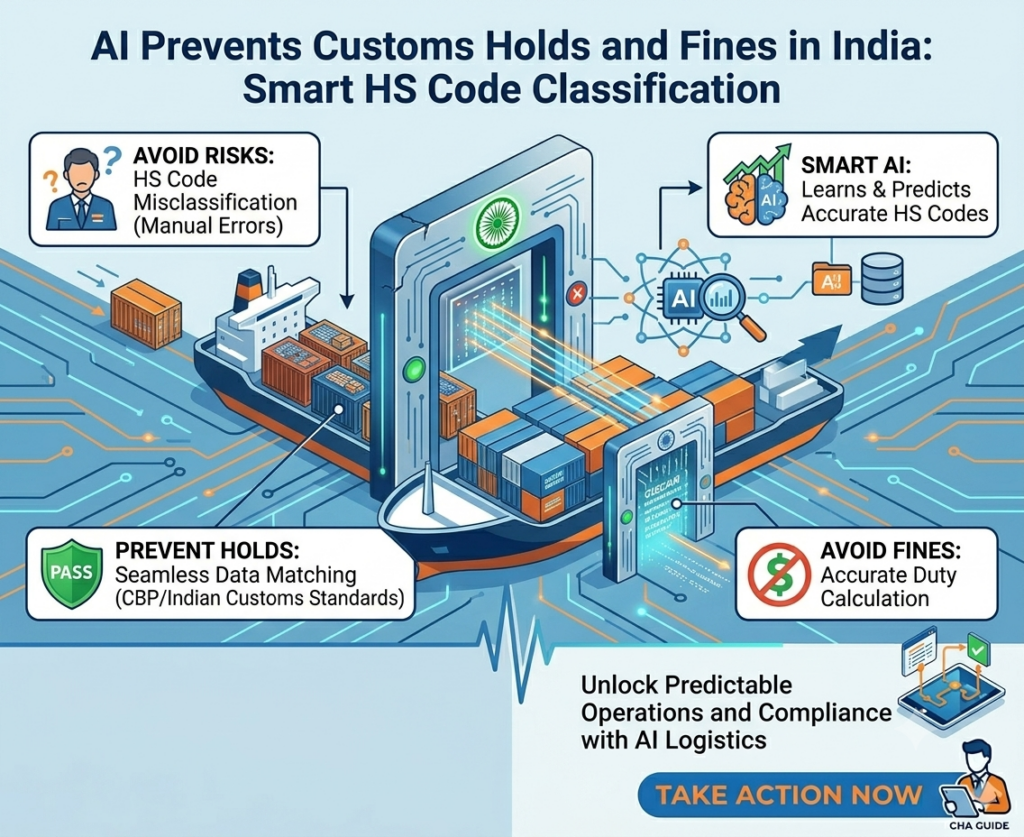
This post breaks down exactly how HS Code misclassification happens in real CHA operations, what it actually costs, and how AI-powered cross-referencing catches errors before they reach the assessing officer.
How HS Code Misclassification Actually Happens in CHA Operations
The common assumption is that HS Code errors come from incompetent staff. That’s rarely the case. In practice, misclassification happens because India’s customs tariff schedule is genuinely ambiguous for a significant percentage of real-world goods, and the process of manual classification under time pressure compounds the risk.
1. Ambiguous goods descriptions on commercial invoices
The HS Code classification process starts with the goods description on the commercial invoice. But exporters write descriptions for commercial purposes, not customs purposes. An invoice might say “plastic container with metal lid, 500ml, for food storage” — but the customs classification depends on whether the item is primarily plastic (Chapter 39), primarily metal (Chapter 73), or a composite article (Chapter 39 with heading-level rules determining the classification). The same physical product can legitimately fall under 2-3 different tariff headings depending on interpretation.
2. The 12-digit specificity trap
India uses a 12-digit HS Code structure: the first 6 digits follow the international Harmonized System, digits 7-8 are the ASEAN-specific subheading, and digits 9-12 are India-specific. At the 6-digit level, classification might seem clear. But the duty rate is determined at the 8-digit or 12-digit level, where subtle distinctions multiply.
Take textiles. Cotton fabric falls under Chapter 52. But the specific heading depends on weave (plain vs twill vs satin), weight (below or above 200 g/m²), thread count, whether it’s bleached, dyed, or printed, and whether it contains any synthetic fibre blend. A manual classifier handling 30 different textile shipments per month has to navigate these distinctions correctly every single time.
3. Time pressure and volume
A mid-sized clearing house agent processes 20-50 import jobs per day. Each job has 5-20 line items, each requiring independent HS Code classification. That’s 100-1,000 classification decisions per day, each made by a human clerk cross-referencing a goods description against the Indian Customs Tariff Act schedules. Under this volume, even experienced classifiers make errors at a rate of 5-10% on complex goods categories.
4. Exporter-declared codes are unreliable
Many CHAs default to using the HS Code printed on the exporter’s invoice. This is risky for two reasons. First, the exporter uses their country’s tariff schedule, which differs from India’s at the 8- to 12-digit level. Second, exporters have an incentive to under-classify (lower declared value, fewer restrictions) while Indian customs assesses based on the correct Indian classification. Blindly copying the exporter’s code shifts the compliance risk entirely onto the CHA.
How Strong Is Your HS Code Verification Process?
Our customs 2.0 Readiness Checklist includes a specific checkpoint on HS Code validation before filling. Download the free checklist now to see where you stand.
What HS Code Misclassification Actually Costs Your CHA Operation
The financial and operational consequences of HS Code errors are far larger than most clearing house agents quantify, because they cascade across multiple dimensions:
Immediate: assessment queries and delays
Under faceless assessment, the assessing officer reviewing your Bill of Entry has no physical access to the goods or the importer. Their entire evaluation is based on the declared data and supporting documents. When the HS Code looks questionable — a goods description that doesn’t cleanly match the declared tariff heading — they raise a query.
Each query adds 24-72 hours to clearance time. CBIC has capped queries at three per Bill of Entry, but even one query on HS Code classification can stall clearance for days while your team prepares a justification, gathers supporting documents, and responds through ICEGATE. During this time, your client’s cargo sits at the port, incurring demurrage and detention charges.
Escalation: RMS flags and physical examination
India’s Risk Management System (RMS) maintains pattern-recognition algorithms that flag shipments for physical examination based on risk indicators. Frequent HS Code queries, mismatches between declared and assessed classifications, and specific commodity-plus-origin combinations all increase your RMS risk score. Once flagged, the shipment is diverted from the automated clearance pathway to physical examination — adding days and eliminating any possibility of Auto Out of Charge.
Financial: duty differentials, penalties, and interest
When misclassification is detected, the importer owes the differential duty plus interest at 15% per annum from the date of import. Under Section 28 of the Customs Act, CBIC can demand duty recovery for up to 5 years for non-fraudulent misclassification and up to 5 years with a penalty for wilful misstatement. Penalty under Section 112 can range from ₹10,000 to the value of the goods. For high-duty-differential items (electronics, textiles, chemicals), a single misclassification can result in lakhs of additional duty and penalty.
Severe: seizure under Section 111
In cases where CBIC determines that misclassification was deliberate — to evade duty, circumvent anti-dumping duties, or exploit preferential tariff rates — the goods are liable for confiscation under Section 111 of the Customs Act. Even if confiscation is avoided, the importer faces a redemption fine (typically 10-25% of the goods’ value) plus the full penalty. For a CHA, being associated with a Section 111 case damages your reputation, your AEO eligibility, and your client relationships.
Long-term: AEO status and client trust
Authorized Economic Operator (AEO) status — which provides faster clearance, fewer examinations, and direct port delivery privileges — depends on maintaining high compliance scores. Repeated HS Code errors erode your compliance history, increase your RMS risk profile, and can trigger an AEO status review. Losing AEO T2 or T3 certification means losing the clearance speed advantage that your best clients chose you for.
How AI Cross-Referencing Catches HS Code Errors before Filing
AI-powered HS Code cross-referencing doesn’t replace the human classifier. It gives your classifier a safety net that catches errors before they reach the assessing officer. Here’s how it works in Readerr.io’s customs document automation workflow:
Step 1: Extract the declared HS Code and goods description simultaneously
When the AI processes a commercial invoice and Bill of Lading, it extracts both the declared HS Code (if present) and the full goods description as separate structured fields. This dual extraction is critical because the cross-reference check needs to compare what the exporter declared against what the goods description actually suggests.
Step 2: Cross-reference against India’s customs tariff schedule
The extracted HS Code is validated against the current Indian Customs Tariff Act schedule. The system checks: does this 12-digit code exist in the current tariff? Does the tariff description for this code match the goods description on the invoice? Is the chapter, heading, and subheading consistent with the product category described?
This isn’t a simple lookup. The AI compares the semantic meaning of the goods description against the tariff description at the 4-digit heading level, the 6-digit subheading level, and the 8-12 digit national tariff level. If the goods description says “plastic food container with metal lid” but the declared code falls under Chapter 73 (articles of iron or steel), the system flags the inconsistency.
Step 3: Flag ambiguous classifications for human review
Not every mismatch is an error. Some goods genuinely straddle multiple tariff headings, and the correct classification requires expert judgment. The AI doesn’t auto-correct — it flags. Your reviewer sees the declared code, the goods description, the AI’s assessment of whether they align, and in ambiguous cases, 2-3 alternative tariff headings the goods could fall under. The reviewer makes the final call with full context — not under time pressure, guessing at a 12-digit code.
Step 4: Cross-document consistency checks
HS Code errors often become visible when you compare across documents. The commercial invoice declares an HS Code. The packing list describes the goods differently. The B/L uses a generic cargo description. When these descriptions don’t align, it’s a signal that the HS Code classification may need to review. The AI performs this three-way consistency check automatically — something a human classifier under time pressure almost never does.
Step 5: Historical pattern matching
Over time, the system builds a history of which HS Codes have been used for which goods descriptions from which exporters. If an exporter who normally ships goods under heading 8471 suddenly declares a shipment under 8473, the system flags the deviation. This historical baseline doesn’t exist in manual processes — your classifier treats every job independently. AI sees patterns across hundreds of jobs.
Want to See HS-Code Cross Referencing in Action?
We’ll show you how the system flags misclassifications before filing — using real goods descriptions from your shipments.
Book a 30-minute demoWhy HS Code Accuracy Matters More Under Customs 2.0 Than Ever Before
Three specific changes under CBIC’s Customs 2.0 framework have made HS Code accuracy a make-or-break operational metric for clearing house agents:
1. Faceless assessment limits queries. With a maximum of three queries per Bill of Entry, an HS Code query consumes a significant portion of the assessing officer’s attention budget. If the officer uses one query for HS Code and two for other issues, there’s no room to raise additional concerns, which can lead to outright rejection or an examination referral rather than query-based resolution.
2. Auto OOC rewards clean data. Auto Out of Charge, automatic clearance without officer intervention, is available for shipments that pass RMS screening and have complete, accurate documentation. An HS Code that triggers an RMS flag instantly disqualifies the shipment from Auto OOC. The difference between automated clearance in hours and manual clearance in days often comes down to whether the HS Code was right.
3. Digital audit trail is permanent. Under the paperless framework, every HS Code declared on a Bill of Entry is stored permanently in ICEGATE. CBIC’s data analytics systems can retroactively identify patterns of misclassification across your entire filing history. This means past errors that went unnoticed under manual assessment can surface during post-clearance audits years later.
5 Steps Every Customs House Agent Should Take Today to Wrong HS Coding
1. Stop blindly copying exporter-declared HS Codes. The exporter’s code is a starting point, not the answer. India’s 8-12 digit tariff diverges from most other countries at the subheading level. Every exporter-declared code needs independent verification against the Indian customs tariff before filing.
2. Implement pre-filing HS Code cross-referencing. Whether manual or automated, every Bill of Entry should undergo a goods description vs. tariff code check before submission. The 5 minutes this takes upstream saves the 24-72 hours a query takes downstream.
3. Build an internal classification reference. For your top 50 product categories by volume, maintain a reference table of confirmed HS Codes with supporting tariff descriptions. This reduces the number of classifications your team makes from scratch and creates consistency across your operation.
4. Track your query rate by HS Code category. If a disproportionate number of assessment queries relate to specific commodity chapters (textiles, electronics, chemicals), that’s a signal to invest in specialized training or automated checking for those categories.
5. Automate the cross-reference check. AI-powered customs document processing tools can cross-reference every declared HS Code against the Indian tariff schedule, flag mismatches, suggest alternatives, and verify cross-document consistency — across every job, every line item, every time. This eliminates the human error that manual classification under volume pressure inevitably produces.
Ready to Catch HS Code Errors before They Cost You
We’ll process 500 of your real customs documents, cross-reference every declared HS Code against India’s tariff schedule, and deliver an accuracy benchmark report. Zero cost. Zero risk.
Book a Free Demo NowFrequently Asked Questions about HS Code Classification and Customs Compliance
HS Code misclassification occurs when a product is assigned an incorrect Harmonized System code for customs purposes. In India, this means declaring the wrong 12-digit tariff code on a Bill of Entry, which can result in incorrect duty assessment, customs queries, penalty proceedings under Section 112 of the Customs Act, and in severe cases, cargo seizure under Section 111. Misclassification can be unintentional (ambiguous goods description, complexity of the tariff schedule) or deliberate (duty evasion).
Penalties for HS Code misclassification in India include: differential duty plus 15% annual interest from the date of import, penalty under Section 112 of the Customs Act (ranging from ₹10,000 to the value of goods), redemption fine of 10-25% of goods value if confiscation proceedings are initiated under Section 111, and extended recovery periods of up to 5 years under Section 28. Repeated misclassification can also impact AEO status and increase RMS examination rates.
AI helps with HS Code classification by cross-referencing the declared code against the Indian customs tariff schedule, comparing the goods description against the tariff description at heading and subheading levels, flagging inconsistencies for human review, performing cross-document checks (invoice vs B/L vs packing list), and identifying historical deviations in coding patterns. AI doesn’t replace the human classifier — it provides a pre-filing safety net that catches errors before they reach the assessing officer.
HS Code validation typically means checking whether a code exists in the tariff schedule — a basic lookup. HS Code cross-referencing goes further: it compares the semantic meaning of the goods description against the tariff description at multiple levels (heading, subheading, national tariff line), identifies potential mismatches, and suggests alternative classifications when ambiguity exists. Cross-referencing catches errors that pass a simple validation check.
India uses a 12-digit HS Code structure. Digits 1-6 follow the international Harmonized System (maintained by the World Customs Organization). Digits 7-8 are the ASEAN-level subheading. Digits 9-12 are India-specific national tariff lines defined by CBIC. Customs duty rates are determined at the 8-digit or 12-digit level, where subtle classification distinctions can mean significant duty rate differences.
Yes. Authorized Economic Operator (AEO) status in India depends on maintaining high compliance scores, including customs classification accuracy. Repeated HS Code queries, assessment disputes, and penalty proceedings erode your compliance history and increase your RMS risk profile. This can trigger AEO status review, potential downgrade from T3 to T2 or T1, and loss of facilitated clearance privileges including Auto OOC and direct port delivery.